What a Cracker Box Knows That a Clothing Label Doesn't
Food labels are standardized for ingredients and nutrition, but even they say little about environmental impact — that layer is voluntary in food and in clothing. Here is what that asymmetry really looks like.
There are two spiritual dangers in not owning a farm. One is the danger of supposing that breakfast comes from a grocery, and the other that heat comes from the furnace.
The most honest thing in my kitchen is a cracker box. It names its grain, names the standard that grain was grown under, and prints, in plain words, an argument for caring about the soil it came from. Some clothing companies reach for that kind of honesty — on hangtags, in store displays, in impact reports — but a shopper can't count on it from rack to rack, because the standardized garment tag asks for none of it. This article is about why that gap exists, why food labeling is a better model than most people realize — and a more incomplete one — and why clothing, a daily necessity like food, deserves the same seriousness of disclosure.
I bought a box of sourdough sea salt crackers at a local grocery store. On that package, Patagonia Provisions asks a question most food companies never have to answer: "Why is an outdoor clothing company making food?" The box responds with an argument about soil and water, then quotes founder Yvon Chouinard: "People buy a jacket every few years, but they eat several times a day. If we're going to save our home planet, it starts with food."
Another panel poses a smaller question with a bigger reach: "Can a cracker save the world? In a word, no. But if it's part of something bigger — real change in how we produce food — we think it can." The front of the box identifies the wheat as Regenerative Organic Certified, and the ingredient panel names organic stoneground wheat flour. Those are statements on one company's package, not proof that one cracker has delivered a measured environmental benefit. But the willingness to name a crop and explain how it was grown is worth examining, because most products — food included — are not required to do anything like it.
I came to clothing fiber through food and agricultural thinking, not the other way around. Leopold's warning about the grocery and the furnace is about forgetting origins — letting a finished product hide the land and the labor that made it. A garment doesn't begin on a rack, either. For cotton, linen, hemp, or wool, its story runs through land, water, living systems, and people before it becomes a shirt. Synthetic fibers start somewhere else — a refinery rather than a field — but the same question applies: what happened upstream, and who will tell you about it?
Fashion is the pitch; fiber is the need
There is a vocabulary problem underneath all of this, and it's not small. The industry that makes our clothing calls itself fashion, and fashion conveys style — taste, season, identity. Style is real, and people deserve it. But style is the pitch, not the need. What a garment actually answers each morning is closer to what breakfast answers: shelter. Warmth, protection, the daily covering of a body. Food and clothing meet the same class of human need — material, grown or made, processed, and delivered to the body — one taken in, one put on. Both are fiber that we need.
That word — need — is what licenses the comparison this article is making. When something is a daily necessity sitting that close to the body, we treat knowing what's in it as a right, not a curiosity. We already act on that belief in the grocery aisle, where a standardized panel meets every shopper on every package as a matter of course. Clothing never received that seriousness, and the style framing helps explain why: optional-seeming things don't get disclosure floors. But the product is not optional. Everyone dresses, every day, in every climate, at every income. Marketing it as pure style sold more garments and excused the industry from food-grade scrutiny at the same time.
So the standard this article argues for is simple to state: clothing companies should be held to the same stewardship and transparency standards we hold food companies to. Not because the two industries are identical, but because their products answer the same class of need, from the same starting point — land and labor — and a need that universal deserves a floor that universal. Food hasn't finished building that floor yet, as we're about to see. But food has a floor for what's inside, a legally defined vocabulary for stewardship claims, and a habit trained into every shopper. Clothing can reach at least that bar. It is hard to defend why its necessity should get a lesser standard of honesty.
What the standardized food label actually standardizes
The food label is often held up as the gold standard of disclosure. It's worth being precise about what that standard covers, because it is narrower than the cracker box makes it seem.
Since the Nutrition Labeling and Education Act of 1990, most packaged foods in the United States carry a standardized ingredient list and Nutrition Facts panel (21 CFR §101.4; §101.9). The machinery under that panel is worth pausing on, because the machinery is the part clothing never received. Ingredients must be declared by common or usual name, in descending order by weight. An ingredient present at two percent or less may be folded into a trailing statement — "Contains less than 2% of ___" — so minor ingredients stay disclosed without crowding the list (§101.4(a)(2)). Serving sizes follow defined reference amounts, and nutrients report against standardized Daily Values. The rules reach all the way down to the order, the thresholds, and the format itself — which is the point. Every package answers the same questions, in the same order, in the same shape, so a shopper's reading skill transfers from cereal to crackers to soup, and any two packages can be compared in any store without learning a new grammar.
Here is the part that matters for this article: the standardized panel says nothing about how the wheat was grown. Nothing about tillage or cover crops, pesticide application, irrigation source, soil health, farm labor, or what happened to the land downstream. The most celebrated disclosure standard in consumer goods is a standard about composition, not impact. A nutrition label will tell you the sodium per serving of two identical-looking crackers and stay silent on whether one was grown in a way that degraded a watershed and the other wasn't.
The cracker box fills that silence voluntarily. USDA Organic is a legally defined, federally enforced labeling term with specific production rules behind it (USDA organic certification). Regenerative Organic Certified is a private third-party standard with its own pillars and auditors. A company chooses to carry either one. If it makes no such choice, its label is still perfectly legal — and it still tells you nothing about the farm.
So food disclosure has two layers: a standardized, mandatory floor (what's inside), and a voluntary, legally defined upper layer (how the certified portion was produced). The floor created something crucial that the voluntary layer depends on: a habit. Generations of shoppers learned to turn the package over. The environmental layer didn't have to teach anyone to read; it met shoppers at a standardized choice they already knew how to make.
What the clothing label standardizes
Clothing has a standardized floor too. For most covered textiles sold in the United States, the FTC requires the generic fiber names and percentages, the country of origin, and the identity of the manufacturer or another responsible business (FTC textile labeling guidance). Care instructions run under a separate rule. The FTC even polices what fibers may be called — fabric spun from bamboo pulp generally must be labeled rayon, not "bamboo."
Notice the mirror, because it is closer than it looks. The clothing floor is the ingredient list's nearest cousin: a declaration of contents by percentage weight. "60% cotton, 40% polyester" is the same gesture as an ingredient list in descending order — right up to the moment it stops. The floor answers what is this made of at the level of generic names, and quits.
And this is where Christmas Vacation quietly earns a citation. Anyone who has seen it remembers that Clark Griswold — the most earnest man in American cinema — holds down a serious technical job at a cereal company: he is the man who keeps the flakes crispy. Ask him about it and he lights up like a proud engineer, because the product really is clever. A coating, sprayed onto breakfast, that seals each flake so milk cannot get in. He even names it plainly, which is the whole joke: it's varnish. Non-nutritive cereal varnish. The film said the guilty part out loud in 1989, and nobody in the audience blinks, because everyone recognizes both halves of the gag. A lacquered breakfast flake is entirely believable. And an ingredient list would never, in a hundred years, call it varnish — it would call it something long, chemical, and unpronounceable, which is precisely the problem the folk rule of thumb (if you can't pronounce it, don't buy it) grew up around.
What makes it satire instead of a throwaway gag is the man delivering it. Clark is decent, hardworking, technically fluent, and genuinely proud of a sophisticated food-science achievement — a smart, sincere professional given a serious title, a lab, and a problem nobody needed solved. That is the uncomfortable mirror. The system does not hire villains to varnish the breakfast supply; it hires likable geniuses and gives them crunch to enhance. The shopper is not in that room. The label is the only representative the shopper sends to the meeting, and the label was never going to say varnish.
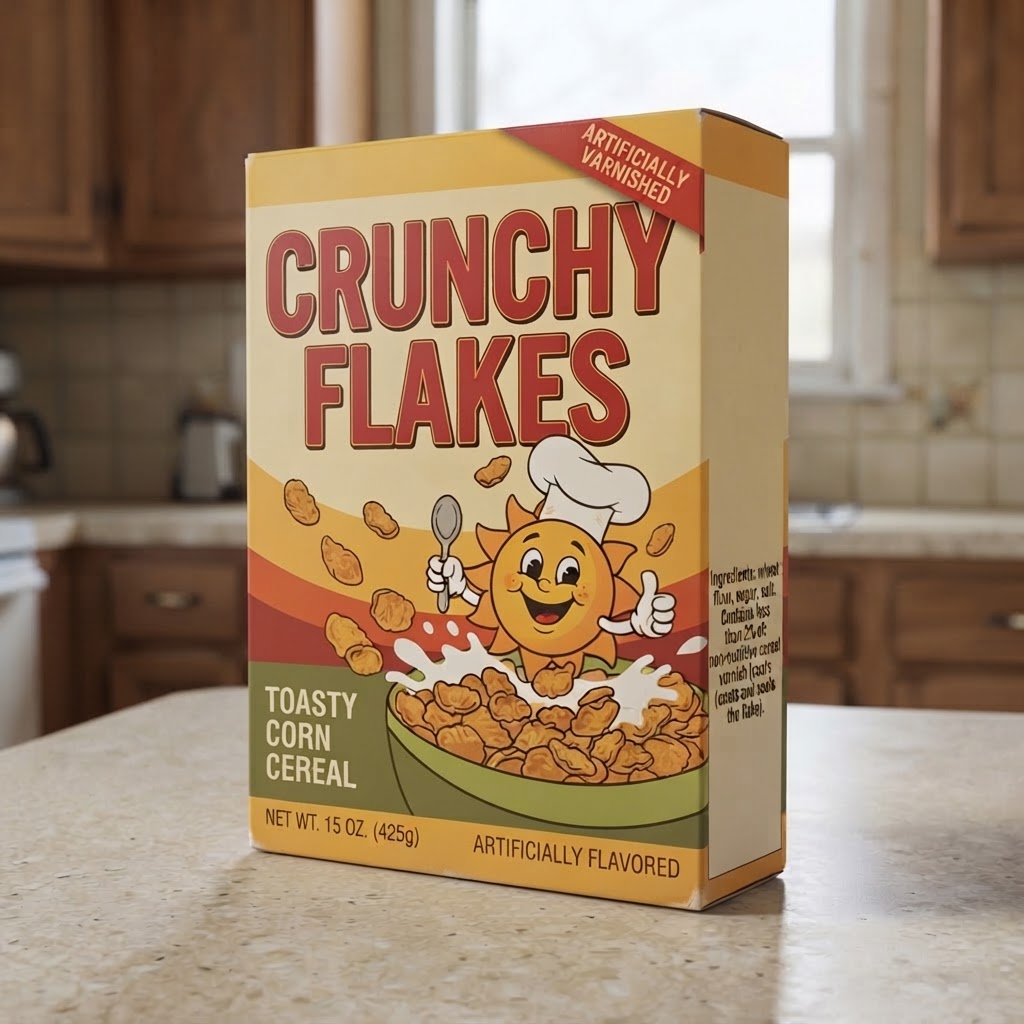
The food floor standardized disclosure, in other words, but never standardized legibility. A panel can list everything and still tell a shopper nothing, if the names on it are written for the file cabinet rather than the kitchen. The pronunciation test is not chemically sound — plenty of benign ingredients wear frightening names, and plenty of harmful ones sound friendly — but its existence is the evidence: when disclosure is technically complete and practically unreadable, people invent folk tests to fill the gap. Clothing's floor has the opposite defect. "Polyester" is not a chemical name hiding behind vocabulary; it is a plain, pronounceable, government-approved word that names the fiber and nothing else — no feedstock, no process, no indication of what came out of the pipe. One aisle says nearly everything in words many shoppers can't parse. The other says almost nothing in words anyone can. Both arrive at the same place: a shopper holding a product they cannot actually see into. Whatever panel clothing eventually gets has to learn from both aisles — food's completeness without its chemistry-set vocabulary, and its own clarity without its silence.
For all its limits, the food floor covers the ingredient the shopper is about to put in their body. The clothing floor covers the material the shopper is about to put on their back — and stops there. There is no standardized panel, mandatory or otherwise, where a garment reports anything comparable about its production: where the cotton was grown, how it was irrigated, what dyed it, who sewed it, or what its maker can substantiate about its end of life.
The real asymmetry
It is not accurate to say food companies disclose and clothing companies don't. Some clothing companies disclose a great deal — supply chain maps, facility lists, farm-level certifications, third-party audits. Nor is food a finished model: its environmental layer is voluntary, and its mandatory panel ignores impact entirely.
The real asymmetry is structural. In food, the voluntary environmental layer rests on a standardized floor that trained shoppers where to look, and it borrowed a legally defined vocabulary — "organic" means something specific and enforceable — so the layer could be consistent across brands. In clothing, the environmental layer has no floor to rest on. Disclosure lives in hangtags, campaign pages, PDF reports, and certifications whose scopes don't overlap: USDA's organic rules apply to fiber crops (AMS certification page — the program explicitly covers crops grown for food or fiber), but the finished garment sits outside the organic claim: USDA's own textile guidance allows a label to name its certified organic fibers, while the finished product may not be called USDA organic unless it is itself certified to the regulations (AMS Organic Textiles). Processing is exactly where GOTS picks up — the standard describes itself as starting where organic farming ends, certifying each company in the processing chain.
The same seal can even appear in both aisles while covering different amounts of the product. On the cracker box, organic certification reaches the crop and the handling that follows it (AMS certification page — the certified categories include crops and processed products that have been handled and packaged). On a cotton shirt, it can reach the crop and stop before the fabric exists. One term, two coverages — and only one aisle prints the difference where the shopper is standing.
So a clothing shopper who wants the cracker box's level of information has to assemble it from pieces: a farm claim under one standard, a processing claim under another, a labor claim under a third, held together by the brand's own narrative. A food shopper at least gets the floor for free. The problem isn't that no clothing company discloses well — some do. The problem is that disclosure quality is unpredictable, and there is no standardized place on the garment where production information belongs.
Put side by side, the comparison looks like this:
| Food aisle | Clothing rack | |
|---|---|---|
| Mandatory floor | Ingredient list by weight; Nutrition Facts; allergen declarations | Generic fiber names and percentages; country of origin; responsible company |
| What the floor never says | How the crop was grown; land, water, and farm-labor conditions | Farm or feedstock; processing; facilities; labor; end of life |
| Stewardship layer | Voluntary, but with a federally defined anchor term (USDA Organic) | Voluntary, private standards only (GOTS, ROC); no anchor term |
| Where the shopper looks | The same panel, every package | Wherever each brand decides |
The table is the argument in one view: food standardized the floor and left impact to a voluntary layer with at least one consistent word on it; clothing standardized a floor that stops at identification and left impact to a patchwork.
The bridge: one company, both aisles
Patagonia is useful here precisely because it operates on both sides of the asymmetry. Through Patagonia Provisions it sells food that can carry the food system's strongest voluntary claims — the cracker box pairs its organic wheat with a regenerative certification and an argument about soil. Through its apparel it sells garments whose floor label says fiber percentages and a country, and whose deeper production story, when it is told at all, is told through reports and certifications rather than anything a shopper can standardize against a second shirt.
The same company, holding the same land ethic, can print a legible agricultural argument on a snack box and has no standardized place to print the equivalent on a jacket.
The pattern repeats in the beer cooler. Deschutes Brewery, Patagonia Provisions' brewing partner, says its Non-Alcoholic Organic Golden is brewed with certified organic Kernza, organic barley and hops, and Regenerative Organic Certified rye, with ingredients "grown in ways that improve soil health, minimize erosion, preserve biodiversity, and protect waterways" (Deschutes partnership page). Those are the producers' claims, not independently measured outcomes for any given can. And one distinction must be kept straight: the crackers I bought list wheat, not Kernza. Kernza belongs to the beer. Kernza is a perennial grain developed by The Land Institute, bred to stay in the ground year after year with a deep root system — a genuinely different agronomic proposition from annual wheat, whatever either crop ends up contributing. Conflating the two would be exactly the kind of label sloppiness this article exists to argue against.
What a standardized production floor for clothing would look like
Held to the same standard as food, in other words. The comparison is not rhetorical decoration — it's the argument. A fiber that shelters the body merits at least the disclosure seriousness we grant a fiber that feeds it.
The ask is not a new certification. It's a floor. Something analogous in spirit to the ingredient list: a standardized panel, in a consistent place, that answers baseline production questions for every garment, the way the ingredient panel answers baseline composition questions for every package of food. It would report what the maker knows and can substantiate about fiber origin and farm or feedstock, major processing steps, the facilities involved, what any certification on the tag actually covers, and what happens at end of life. And it would carry one rule the food aisle never adopted: plain language from the start. A standardized panel written in words a shopper can read at a rack is what keeps disclosure from curdling into a cereal varnish with better paperwork. A missing answer should appear as a visible gap, not vanish into an adjective like "conscious" or "eco" — terms the FTC's Green Guides already caution against in unqualified, general forms (16 CFR §260.4).
Two honest caveats belong in the ask. First, a floor has to be designed so a small producer can stand on it — disclosure that only multinationals can afford would entrench the problem it's meant to solve. Second, a floor reports claims and evidence, not guaranteed outcomes; the food system shows that standardizing a panel doesn't standardize what happens on the land. What a floor standardizes is the shopper's choice: the same answers, in the same place, for every garment — so the freedom to choose what to wear, and what to support, stays where it belongs: with the person weighing their choice.
PWW's Integrity Score is a step in that direction — a consistent place to look, evaluating evidence brands actually make available — but it is one site's methodology, not a standard. The food label's history suggests the real thing gets built the same way the food one did: by many parties — growers, makers, researchers, advocates, and shoppers — cooperating until the floor becomes ordinary.
What an honest dollar buys
Stewardship standards are not a tax on shopping. They are how a dollar buys more than fabric.
A garment made from fiber produced sustainably rather than extractively pays out along several lines at once — and almost none of them appear on a price tag. It fits physical wellness: clothes that fit protect us from the elements and can genuinely change how a day feels — our article on natural fibers and dopamine dressing explores that connection. It fits social wellness: when a garment fits and feels like ours, we can wear styles we actually like and be ourselves in them, rather than settling for whatever the industry assumed our body wanted. It fits mental wellness in two directions: clothes we are comfortable in let us work in whatever capacity we have chosen without wardrobe friction, and a purchase we actually understand doesn't leave behind the mental clutter of waste — the unworn things, the regrets, the closet that doesn't serve the person paying for it. And it fits financial wellness, because a garment that delivers all of the above is where the real value of the dollar lives. Cheap extracted fiber is only cheap at the register.
The connection back to the label is direct. None of that value can be captured by a shopper who can't see it. A standardized production floor is what lets a dollar vote for regenerative fiber instead of extractive fiber — for durability instead of disposal — without a research project. The industry's current answer is that the information exists somewhere, in some report, behind some claim. The food aisle's history says the value only becomes universal when the disclosure is universal.
Leopold's two dangers are about forgetting where things come from. The food label never solved that problem; it just built a standard window onto one part of it, and a voluntary layer of farmers and certifiers has been climbing through that window ever since. Clothing has no window yet. The land underneath both aisles is the same land.
Read next: The Fiber Guide: what clothes are made of, and what their labels leave out.
Patagonia is a PWW affiliate partner. Its food and beer appear here as examples of production-claim disclosure, not as purchase recommendations; this article contains no affiliate product links. PWW has not established whether its affiliate arrangement covers Provisions products. The companion /brand/patagonia-provisions evaluation remains an unpublished draft.
Explore the Framework
Related Reading
Soil to Shopper: The Miles Hidden in Your Clothes
Every garment has a travel history, and the label only shows one stop. Inside the transparency metric PWW is building — and why miles matter without telling the whole story.
5 min readPWW Behind the ScenesWe Corrected Our Own Scores. Here's Why That's the Point.
PWW went back through every brand and corrected its own scores — what changed, why a flat 'perfect 10' was never a real evaluation, and what the five-category methodology actually checks.
5 min readPWW Behind the ScenesThe SEO Work Behind Affiliate Approval — and How You Can Help
Every affiliate link on this site passed a network review before it existed. Here's the SEO, integrity, and disclosure work that goes into earning one — and what readers who want to help PWW can actually do.
7 min read